
Listen
Press play on honest conversations about travel, culture, and the people who shape each place.
A Journey of Knowledge, Civilization, and Dialogue
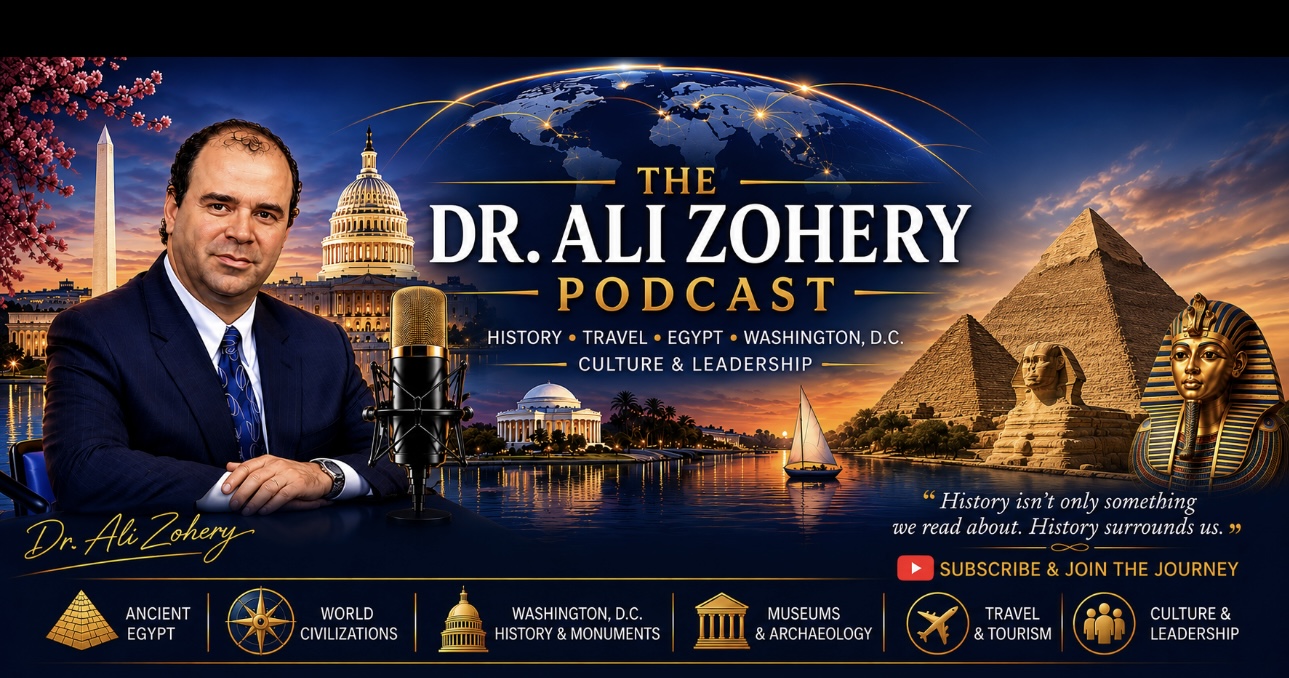
Behind every achievement is a story worth telling. From studying archaeology in Egypt to tourism, guiding, and media in Washington, Dr. Ali Zohery shares the stories of scholars, thinkers, and entrepreneurs, and invites the audience into a thoughtful dialogue that connects Egypt with the world.
Listen, Read, and Explore.
A warm, wandering conversation about journeys, stories, and the ideas that move us. Press play, settle into the notes, and follow each episode out into the world that inspired it.
Press play on honest conversations about travel, culture, and the people who shape each place.
Settle into the show notes — essays, reflections, and notes that open up every episode a little more.
Follow each story outward to the destinations, books, and sounds that started the journey.
Zohery Tours has spent nearly forty years guiding visitors through Washington, D.C. and its landmarks. Discover the company's mission, its public and private sightseeing tours, cultural and digital programs, The Dr. Ali Zohery Podcast, and its belief in tourism as a bridge between peoples.
Capitol Hill and the National Mall offer two essential ways to read Washington, D.C. — one reveals how American government works, the other presents the nation's public memory through monuments and museums. This guide helps first-time visitors choose by interests, time, and pace, and shows how to combine both.
A self-guided Washington, D.C. tour eBook gives independent visitors more than a list of landmarks — it offers a thoughtful framework for seeing the capital with purpose. Learn how to plan by district, balance monuments with museums, add interpretation to every stop, prepare for a flexible day, and know when an eBook is enough and when a live guide adds more.
Can we explore Egypt without leaving Washington, D.C.? This issue of the Dr. Ali Zohery digital magazine traces a living conversation between ancient Egypt and the American capital — the Washington Monument as an echo of the obelisk, Maat and the Lincoln Memorial, and the Nile and the Potomac as rivers of memory and knowledge.
George Washington's Mount Vernon is more than a handsome historic home — it is where the origins of the republic, plantation labor, and a founding figure's private world meet on a Potomac landscape. This review weighs whether the excursion earns a place in your Washington itinerary and how to plan a visit that goes beyond the mansion.
A featured tour review tracing the Potomac from the 18th-century seaport of Old Town Alexandria to the private sanctuary of George Washington's Mount Vernon. Walk cobblestone corridors, the George Washington Memorial Parkway, and the working grounds of the first president's estate with scholar-led commentary that turns a day trip into an immersive seminar on colonial life and revolutionary statecraft.
Issue 24 of the Dr. Ali Zohery digital magazine follows a historic route from Old Town Alexandria to Mount Vernon — the home and estate of George Washington. Through the mansion's rooms, gardens, farms, workshops, tomb, and river view, the issue traces family life, hospitality, agriculture, leadership, and the labor of enslaved men, women, and children who sustained the first president's world.
A memorial inscription is never merely decoration — it is a public argument about what deserves remembrance. This guide shows how to slow down and read Washington, D.C.'s monuments with context: notice placement, identify who is speaking and when, read the full passage, weigh language and symbolism, and consider what the inscription leaves out, so a visit becomes a careful encounter with history rather than a sequence of photographs.
A captivating Daily Washington, D.C. Sightseeing Podcast episode in which Dr. Ali Zohery walks through the Smithsonian National Museum of American History — the Star-Spangled Banner, the American Presidency and First Ladies, the Greensboro Lunch Counter, and the music and inventions that shaped everyday American life — and shows why a scholar-led Zohery Tours visit turns millions of artifacts into an unforgettable national narrative.
How can a flag, a lunch counter, a writing desk, or a pair of shoes explain the history of a nation? This issue of the Dr. Ali Zohery digital magazine accompanies a podcast journey through the Smithsonian National Museum of American History — the Star-Spangled Banner, the American Presidency and First Ladies, the Greensboro lunch counter, invention, music, and everyday life — and shows how objects become historical sources when curiosity turns them into questions.
Issue 21 visits the Smithsonian National Museum of African American History and Culture on the National Mall — the only national museum devoted exclusively to African American life, history, and culture. Through its corona-shaped landmark, descending history galleries, and community, military, sports, and music exhibits, the issue traces how African American history is essential to the American story, from slavery and Reconstruction to the long civil rights movement, achievement, and hope.
Issue 22 visits the Smithsonian National Museum of Natural History in Washington, D.C. and concentrates on Eternal Life in Ancient Egypt — its permanent exhibition on mummification, burial, belief, and the afterlife. Through human and animal mummies, coffins, amulets, and funerary objects, the issue traces how a civilization along the Nile understood death, identity, and the eternal journey, and how modern imaging now reads the dead with science and dignity.
A successful student visit to Washington, D.C. is measured by the questions students carry home, not the landmarks in a class photo. This full-day school trip itinerary example balances the National Mall, the U.S. Capitol, a Smithsonian museum inquiry session, the White House area, and the World War II, Vietnam Veterans, and Lincoln memorials with regular breaks and guided interpretation — a model middle school, high school, and introductory college groups can adapt to their goals.
The Washington Monument is often misunderstood as a literal copy of an Egyptian obelisk. This field guide shows how Egyptian Revival architecture in Washington, D.C. actually works — the obelisk as a republican reinvention, the House of the Temple's layered sphinxes, and how to read battered walls, pylons, and temple entrances as evidence of how a young nation borrowed the authority of deep time rather than the ornament of palaces.
Yes — the great outdoor memorials of the National Mall are free to enter, but a thoughtful visit takes planning. This guide explains what is genuinely free, where timed tickets and reservations matter (the Washington Monument, U.S. Capitol, White House, Smithsonian museums), what can add cost to your day, and how to arrange the Mall's memorials into a meaningful story of the republic, sacrifice, civil rights, and democracy.
Washington, D.C. changes character as the day progresses — a civic textbook in stone by morning, and a city of symbols and remembrance after dark. This guide compares day and night tours by access, atmosphere, season, and energy, shows what each does best, and explains how to pair them for the fullest understanding of the capital.
The best student travel programs in Washington, D.C. turn a visit into a living classroom — where students observe, question, and connect evidence rather than checking off landmarks. This guide shows how to shape programs by grade level and curriculum, choose scholar-led interpretation, build an itinerary that leaves room to learn, prepare students before they arrive, and give reflection a place so the trip becomes durable learning.
A visit to the Lincoln Memorial can last ten minutes or become a study in national memory, civil rights, and public space — and that difference often comes down to the private tour versus group tour decision. This guide compares what each format offers, the meaningful differences in control and customization, when a group tour is the better choice, when a private tour is worth it, and how to choose the experience that supports your purpose in Washington, D.C.
A memorial can be seen in seconds and misunderstood for years. This guide shows how walking tours give visitors the pace required to read Washington, D.C.’s monuments and neighborhoods as a coherent civic argument — from the National Mall’s visual axis of founding and memory, to the Vietnam Veterans Memorial’s rethinking of classical form, to the neighborhoods whose row houses and churches tell the story of a real city, not a federal backdrop.
From James Smithson’s bequest to the world’s largest museum and research complex — Issue 19 tells the story of the Smithsonian Castle, the red sandstone landmark on the National Mall that became the first permanent home of the Smithsonian. Through James Smithson’s unlikely gift, the Act of 1846, Joseph Henry’s first program, James Renwick Jr.’s Norman Revival design, the fire of 1865, and the modern network of museums it seeded, the issue traces how a single building became the symbolic heart of an American institution of knowledge.
A Visit to the Martin Luther King Jr. Memorial in Washington, D.C. — Issue 18 follows Dr. Ali Zohery on an educational journey through the life of Dr. Martin Luther King Jr. and the memorial beside the Tidal Basin. From the Montgomery Bus Boycott and the March on Washington to the Mountain of Despair, the Stone of Hope, and the Inscription Wall, the issue traces how a Baptist minister, scholar, and organizer turned faith and nonviolent resistance into disciplined action for racial justice, economic justice, and peace.
From the Wright Flyer to Apollo 11 and the future of space exploration — Issue 20 visits the Smithsonian National Air and Space Museum in Washington, D.C. Explore the 1903 Wright Flyer, the Apollo 11 command module Columbia, Buzz Aldrin’s lunar spacesuit, and the courage, research, engineering, and cooperation that turned humanity’s dream of flight into a shared global horizon.
Memory, sacrifice, and humanity — Issue 11 of the Dr. Ali Zohery Podcast Weekly visits the Vietnam Veterans Memorial on the National Mall. From the Vietnam War and its lasting impact on American service members and families to Maya Lin's black granite wall of 58,318 names arranged by date of loss, the Three Servicemen statue, and the Vietnam Women's Memorial, the issue traces how a national history becomes a collection of individual names — each connected to a family and a life — and how remembrance becomes immediate rather than distant.
Architecture, liberty and a complicated legacy — Issue 13 of the Dr. Ali Zohery Podcast Weekly visits the Thomas Jefferson Memorial on the Tidal Basin, from Jefferson's authorship of the Declaration of Independence and the Louisiana Purchase to John Russell Pope's classical rotunda, the bronze statue by Rudulph Evans dedicated in 1943, the inscriptions on the chamber walls, the cherry trees of 1912, and the people Jefferson enslaved at Monticello whose labor sustained his world.
An obelisk at the center of the capital — Issue 14 of the Dr. Ali Zohery Podcast Weekly traces the Washington Monument, from George Washington's life as soldier and first president to Robert Mills's Egyptian-obelisk design, the decades-long interruption that left the marble two colors, the aluminum tip inscribed Laus Deo, the observation deck, and the people enslaved at Mount Vernon whose labor sustained his world.
The Franklin Delano Roosevelt Memorial is one of Washington, D.C.'s most thoughtful presidential memorials — a sequence of outdoor rooms that interpret twelve years of presidency through stone, water, sculpture, and quotation. This issue of the Dr. Ali Zohery digital magazine traces FDR's journey from Hyde Park to four-term president, the Great Depression and the New Deal, polio and disability, Fireside Chats, World War II and the Four Freedoms, Eleanor Roosevelt's public service, the forced incarceration of Japanese Americans under Executive Order 9066, and what modern leaders can learn from courage, communication, constitutional restraint, and hope.
The Capitol is more than a building at the end of Pennsylvania Avenue — it is the setting for arguments that have shaped the nation. This guide shows how to explore Capitol history as a connected civic landscape: begin with the Capitol as an idea, read its architecture and the Mall's geography of power, include the histories institutions once overlooked, plan for depth rather than distance, and let the questions travel with you beyond the monuments.
The official Capitol tour lasts about 45 minutes, but a realistic visit usually needs 90 minutes to two hours once security, orientation, and exploration are included. This guide explains what shapes the total time — arrival buffers, the Visitor Center exhibits, gallery access, and the Capitol's layered meaning — and helps families, students, and international visitors plan a visit that earns its place in a Washington itinerary.
Announcing the launch of a weekly digital magazine and a permanent educational and cultural archive for The Dr. Ali Zohery Podcast. Each Saturday edition documents an episode in a bilingual Arabic-English article — introducing the guest, presenting the conversation's central questions and ideas, preserving memorable quotations, and linking to the original recording. The inaugural edition features veteran Egyptian broadcaster Mohamed Abdelkarim.
Issue Two of the Dr. Ali Zohery Podcast Weekly — a bilingual conversation with Professor Mohamed Hamza Ismail Al Haddad, Professor of Islamic Archaeology and Civilization and former Dean of the Faculty of Archaeology at Cairo University. The article reads Egypt as a continuous civilization whose layers extend from antiquity through the Coptic, Islamic, and modern periods, exploring what Egyptology means, Islamic Cairo as an open book, architecture and identity, the challenges of heritage conservation, universities and professional training, sustainable tourism, and a message for students and young researchers.
Issue One of the Dr. Ali Zohery Podcast Weekly — a bilingual conversation with veteran Egyptian broadcaster Mohamed Abdelkarim, tracing more than forty five years behind the microphone from Shebin El Kom to Egyptian Radio, Radio Japan in Tokyo, and the Voice of America in Washington. The article follows his training under Ihab El Azhary and Farouk Shousha, the sanctity of the microphone, translation as mathematics, the book On Air, and a careful view of digital media and artificial intelligence.
Issue Four of the Dr. Ali Zohery Podcast Weekly — a bilingual conversation with Prof. Dr. Kehbuma Langmia, Professor and Chair of Communication Studies at Howard University. The article follows a journey from a village in Cameroon to Howard University, tracing how Africa can tell its own story and build its own theories of media and communication: Afrocentricity, Black and diaspora communication, decolonizing communication studies, ancient Egypt and African intellectual history, education and leadership, the digital age, artificial intelligence as copilot, disinformation, deepfakes, and algorithmic bias.
Issue Five of the Dr. Ali Zohery Podcast Weekly — a bilingual lecture by Dr. Ali Zohery recorded at the Cultural and Educational Office of the Egyptian Embassy in Washington. The article reads Egypt as a civilization whose presence extends across the world, and turns the United States into an open classroom: the pyramid and the Great Seal, the Eye of Horus and the Eye of Providence, the falcon and the eagle, the obelisk and the Washington Monument, the Nile and the Potomac, the Temple of Dendur, museums and libraries, restitution and ethics, education as cultural diplomacy, and a shared future of civilizational cooperation.
Issue Six of the Dr. Ali Zohery Podcast Weekly — a bilingual episode presented by Dr. Ali Zohery, founder of Zohery Tours, opening a daily Washington, D.C. sightseeing series. The article presents the United States Capitol not only as the home of Congress but as a living record of American politics, architecture, art, and national memory: the Residence Act of 1790, Pierre Charles L'Enfant's plan, the cornerstone of 1793 and Dr. William Thornton's design, the fire of 1814, the cast-iron dome by Thomas U. Walter, the Statue of Freedom by Thomas Crawford, the Rotunda and The Apotheosis of Washington, the East and West Fronts, and five practical questions every visitor asks.
Pull up a chair. Every episode is an invitation — to listen closely, to read along, and to explore a little further than the story alone can carry you.
New episodes land here as the journey unfolds. Thanks for traveling with us.